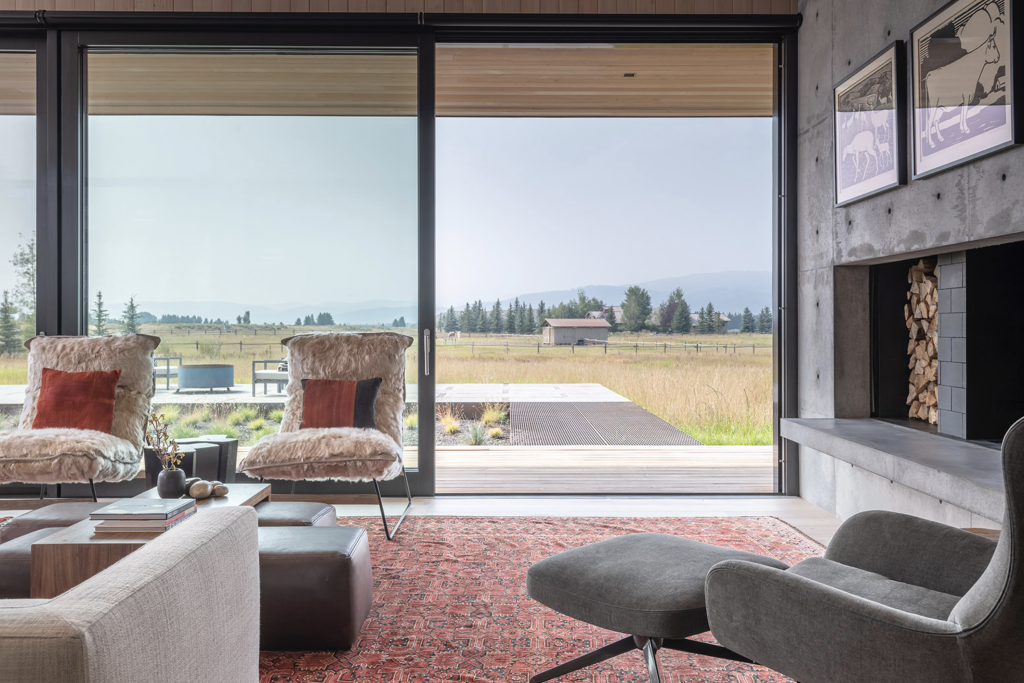
Large sliding doors have become a defining feature of high-end residential architecture, particularly in homes where the boundary between inside and outside is meant to dissolve entirely. A single glazed panel spanning four, six, or even eight meters creates a visual connection that no conventional door can match. But that same scale introduces a practical tension that architects working on luxury residences encounter regularly: the door that defines a space can also make everyday life slightly awkward.
The solution that has gained traction among architects specifying architectural doors for high-end residential projects is the integrated pass door, sometimes called a wicket door or everyday door. Understanding why this configuration exists and how it performs in practice helps clarify when it belongs in a design and when it does not.
The functional gap that large glazed openings create
A lift-and-slide door operating at the scale common in premium residential construction typically weighs several hundred kilograms. The engineering that makes this possible, precision hardware, multi-point sealing, and carefully balanced sash mechanics, is exactly what gives these elements their thermal and acoustic performance. That same engineering means the door is not something you swing open casually to step outside for a moment.
For a beach house, a mountain retreat, or a lakeside villa, the primary glazed opening is often used intentionally: during entertaining, on warm evenings, or when the owners want to fully connect the living space to a terrace or deck. But the same household also needs to carry in groceries, let a dog out, or step onto the terrace without activating the full operation of a large-format sliding element. When the only access point to an outdoor space is a monumental lift-and-slide door, the gap between the door’s purpose and daily use becomes apparent quickly.
How an integrated pass door solves everyday access
A pass door is a standard-width door, typically around 90 centimeters wide, built directly into the frame or sash configuration of a larger sliding door system. It operates independently, opening and closing with the ease of a conventional entry door while the surrounding lift-and-slide elements remain stationary and fully sealed.
The integration is more than a convenience feature. When a pass door is properly engineered as part of the overall system, it shares the same frame profile, glazing specification, and sealing standard as the main sliding elements. This means the thermal and weather performance of the wall opening is not compromised at the location where daily traffic occurs, which is precisely where a weak point would otherwise develop over time. In climates with significant temperature swings, whether a Wyoming winter or a coastal New England autumn, that continuity matters considerably.
From a circulation standpoint, the pass door also reduces wear on the primary sliding mechanism. Lift-and-slide hardware is designed for smooth, frequent operation, but every activation involves lifting a heavy sash off its seal. A pass door handles the routine traffic, preserving the sliding system for the occasions when full opening is the intention.
Design and thermal performance considerations
The visual challenge with any integrated element is maintaining the coherence of the overall composition. A pass door that interrupts the rhythm of a glazed facade can look like an afterthought. When the configuration is resolved well, the pass door reads as a natural part of the system, its frame lines aligning with the surrounding profiles and its glazing matching the adjacent panels in thickness, tint, and proportion.
Profile alignment and visual continuity
In wood and wood-aluminum systems, the pass door frame is typically manufactured from the same profile series as the lift-and-slide elements. This allows the sightlines to remain consistent across the entire opening, so the eye moves across the facade without interruption. The door handle and hardware finish can be specified to match the sliding system hardware, completing the integration at the detail level.
Sealing and insulation at the pass door perimeter
The perimeter of a pass door within a larger system is the point where thermal performance requires the most careful attention. The door must seal against its own frame independently of the surrounding sliding elements, and that seal needs to perform reliably across thousands of open-and-close cycles. In passive house-rated systems, the pass door must meet the same airtightness standard as the rest of the assembly, which places real demands on the door’s hardware, gasket design, and threshold detail. A multipoint locking mechanism pulling the door sash firmly against its seal on all four sides is the standard approach in high-performance configurations.
When architects specify this configuration
The pass door configuration appears most consistently in projects where the large sliding opening is the primary connection between an interior living space and an outdoor area used throughout the day. A great room opening onto a wraparound deck, a kitchen connecting to an outdoor dining terrace, or a master suite facing a private garden are all contexts where the combination makes functional sense.
It is less common in situations where the glazed opening is purely visual, such as a window wall in a double-height space with no direct access, or where a separate entry point already exists nearby. The decision is ultimately about traffic patterns. If the household will pass through that opening multiple times daily in all seasons, a pass door earns its place in the design. If the opening is used primarily for seasonal ventilation or occasional access, the added complexity may not be warranted.
Architects also consider the door’s relationship to the home’s security and locking strategy. A pass door integrated into a large sliding system needs to be independently lockable to a residential security standard, and in some configurations, it can be specified with multipoint locking hardware equivalent to what is used in a premium entry door. This allows the pass door to serve as a secondary entry point without creating a vulnerability in the building envelope.
How Bildau & Bussmann approaches large sliding door systems with integrated access
Bildau & Bussmann manufactures large-format lift-and-slide doors in both solid wood and wood-aluminum configurations, with every element custom-built to the architect’s specifications. For projects where an integrated pass door is part of the design intent, the configuration is engineered from the outset as a unified system rather than a modification applied after the fact. Key aspects of this approach include:
- Pass doors manufactured from the same profile series as the surrounding lift-and-slide elements, maintaining consistent sightlines and frame dimensions across the full opening
- Multipoint locking and perimeter sealing designed to meet passive house airtightness standards independently of the sliding sash system
- Wood-aluminum construction on the exterior shell, available in all RAL colors, providing weather resistance without compromising the warmth of natural wood on the interior face
- Custom configurations accommodating up to four sashes per side, corner units, and pocket systems, with the pass door positioned according to the circulation logic of the specific project
For architects working on high-end residential projects where large glazed openings are a central design element, Bildau & Bussmann functions as a planning partner from early concept through installation, not simply a supplier. To discuss a specific project or explore how a lift-and-slide system with integrated pass door could be configured for your design, get in touch with the team directly.
Ähnliche Artikel
- Lift-and-Slide vs. Multi-Slide vs. Bi-Fold: Choosing the Right Opening System
- Was ein flaches Schienenprofil für die Barrierefreiheit leistet
- Co decyduje o tym, ile miejsca w ścianie potrzebują przesuwne drzwi chowane
- Intégrer une niche murale dissimulée dès la conception
- Dlaczego cieńsze ramy wpuszczają więcej światła dziennego