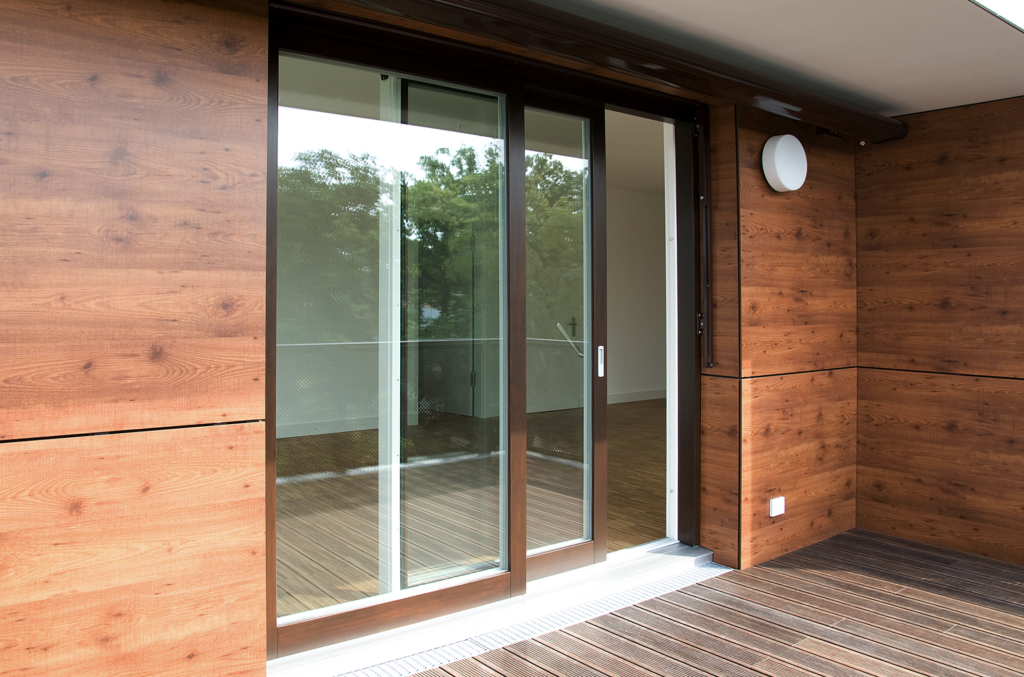
A large sliding door that moves without effort feels almost counterintuitive. Glass panels spanning three meters or more, solid wood frames, multi-point locking systems: the combined weight can easily reach several hundred kilograms. Yet when the hardware is specified and installed correctly, that mass disappears from the user’s perception entirely. Understanding how that happens matters to anyone designing or building at the level where these doors are actually used.
The difference between a heavy sliding door that fights you and one that glides comes down almost entirely to engineering decisions made before a single pane of glass is set. Heavy sliding door hardware is not a commodity category, and the mechanical principles behind premium sliding door systems reward close attention from architects working on high-end residential projects.
The engineering challenge behind large sliding doors
Scale changes everything in door design. A standard interior sliding door weighs perhaps 30 to 50 kilograms, and almost any roller system will handle that load adequately. Move to an exterior wood sliding door with double or triple glazing, and the weight multiplies dramatically. At that scale, the forces acting on the hardware, the track, the frame, and the structural opening all interact in ways that require deliberate engineering rather than standard specification.
Thermal cycling adds another layer of complexity. Wood expands and contracts with temperature and humidity changes, aluminum behaves differently, and glass has its own coefficient of expansion. A large sliding door mechanism must accommodate this movement without binding, without losing its sealing performance, and without placing uneven loads on its rollers. The hardware is essentially managing a living assembly, not a static one.
Roller carriages and track systems that carry the load
The roller carriage is the mechanical heart of any large sliding door. In premium systems, carriages use precision ball bearings or roller bearings rated for continuous loads well above the actual door weight, which builds in a safety margin and dramatically extends service life. The number of carriages per sash, their spacing, and the geometry of the track all determine how evenly the load is distributed across the system.
Track profiles in high-performance installations are typically made from hardened steel or stainless steel, with tight dimensional tolerances that prevent lateral play. Even small amounts of lateral movement at the carriage level translate into noticeable wobble at the leading edge of a wide sash, which affects both the operating feel and the sealing geometry. For wood and wood-aluminum doors, track systems also need to account for the greater mass of solid timber frames compared to aluminum-only alternatives.
Installation precision matters as much as component quality. A track that is not perfectly level, or a structural lintel that deflects under load, will cause the carriage system to work against itself. This is one reason why large sliding door projects benefit from close coordination between the door manufacturer and the structural engineer early in the design process.
How lift-and-slide mechanisms change the operating experience
The lift-and-slide mechanism solves the fundamental tension between sealing performance and ease of movement. In a conventional sliding door, the seals are compressed against the frame at all times, which means the operator is fighting seal friction across the full travel of the door. In a lift-and-slide system, turning the handle activates a multi-point mechanism that raises the sash slightly off its seals before any sliding begins. The door then travels on its rollers with essentially no seal drag.
This mechanical separation of the sealing and sliding functions is what allows sash weights of up to 600 kilograms to be moved with a single hand. The physics are straightforward: rolling friction on precision bearings is orders of magnitude lower than sliding friction against compressed rubber seals. By ensuring these two forces never act simultaneously, lift-and-slide hardware makes the operating weight of the door almost irrelevant to the user experience.
When the handle is returned to the closed position, the mechanism lowers the sash back onto its seals, compressing them uniformly across all contact points. This uniform compression is also what delivers the exceptional airtightness and weather resistance that large glazed openings require, particularly in coastal or mountain environments where wind-driven rain is a regular condition.
Sealing and thermal performance tied to hardware precision
Thermal performance in a large sliding door is inseparable from the precision of its hardware. The U-values achieved by the glazing unit and the frame profile are theoretical maximums: the actual installed performance depends on how consistently and completely the seals engage when the door closes. Hardware that allows even minor misalignment between sash and frame creates thermal bridges and air leakage paths that undermine the entire insulation strategy.
Multi-point locking mechanisms distributed along the height of the sash serve a dual purpose. They provide security, but more relevantly for thermal performance, they pull the sash into uniform contact with the frame seal along its full perimeter. A single-point lock at the handle location leaves the top and bottom corners of a tall sash free to flex slightly away from the frame under wind pressure or thermal movement, breaking the seal. Distributed locking eliminates that gap.
For passive house standard performance, the hardware specification becomes even more demanding. The compression force applied by the locking mechanism, the durometer of the seal material, and the flatness tolerances of the frame all need to be coordinated to achieve the airtightness values that passive house certification requires. This is engineering work, not just product selection, and it is why passive house-rated window and door profiles are always developed as complete systems rather than assemblies of interchangeable parts.
Hardware selection criteria for architects specifying premium projects
When specifying lift-and-slide door hardware for a high-end residential project, load rating is the starting point but not the endpoint. The relevant questions extend well beyond whether a carriage can support the sash weight.
- Cycle life ratings indicate how many open-close cycles the hardware is tested to perform without degradation. For a primary access door in a vacation home, the number may be modest, but for a main living space door used multiple times daily, long-term durability matters considerably.
- Corrosion resistance is non-negotiable for coastal installations. Stainless steel hardware, sealed bearing systems, and corrosion-resistant track coatings are minimum requirements in marine environments.
- Adjustability after installation allows the installer to fine-tune sash height, lateral position, and compression force once the building has settled and the door has gone through its first seasonal cycle. Hardware without adjustment range forces replacement rather than calibration when alignment drifts.
- Handle geometry and operating force should be evaluated together. A handle that requires significant torque to engage the lift mechanism defeats the purpose of the system, particularly for wide doors where the user may be standing at some distance from the locking point.
The relationship between hardware specification and architectural intent also deserves attention. Exposed hardware elements, including handle sets, escutcheons, and visible track covers, contribute to the visual language of the door. In high-end residential work, these details are part of the design, not afterthoughts, and manufacturers who treat hardware as a system component rather than a separate procurement item tend to produce more coherent results.
How Bildau & Bussmann approaches large-format lift-and-slide doors
Bildau & Bussmann manufactures large-format lift-and-slide doors in solid wood and wood-aluminum combinations, with every element custom-built to the architect’s specifications. The lift-and-slide mechanism used in these systems allows sash weights up to 600 kg to be moved with a single handle turn, and the multi-point locking system ensures uniform seal compression across the full sash perimeter. Key capabilities include:
- Configurations with up to four sashes per side, opening from the center or from one side
- Corner units where sashes meet at a 90-degree angle to open an entire corner of the building
- Pocket configurations where sashes retract fully into the wall
- Wood-aluminum construction with thermally separated aluminum profiles, achieving passive house standard performance values
- Aluminum outer shells available in all RAL colors and a wide range of surface textures, manufactured as independent self-supporting frames mounted onto the wood structure
- Rain and wind tightness performance suitable for hurricane-prone coastal regions
For architects working on projects where the connection between interior and exterior space is a central design intention, these doors function as architectural elements in their own right, not simply as large openings. To discuss a specific project or request technical documentation, contact the Bildau & Bussmann team directly.
Ähnliche Artikel
- Was schlankere Profile an den Proportionen einer Tür verändern
- Projektowanie z myślą najpierw o widoku, a potem o ramce
- Ce que les profils plus fins changent aux proportions d'une porte
- XOX, OXXO, XX: Prosty przewodnik po notacji panelowej
- Lift-and-Slide vs. a Standard Slider: What's Mechanically Different